For capital partners
Capital for the transaction. Ownership for the operator. A channel built to repeat.
SEE Acumen Capital is an umbrella through which member independent sponsors, underrepresented operators with documented risk records and aligned capital partners pursue qualifying lower-middle-market acquisitions together. The member sponsor leads the transaction and capital raise. SEE participates as co-GP and contributes operators, acquisition opportunities, capital relationships and governance.
Request the SEE Channel Expansion Brief →The umbrella investment thesis
Expand the ownership channel without lowering the investment standard.
SEE was created by three independent sponsors to address a specific market failure: experienced underrepresented professionals remain largely outside the networks through which lower-middle-market businesses are acquired and wealth is built.
The umbrella converts that excluded talent pool into an investable transaction channel. A member sponsor leads each acquisition. SEE prepares and aligns the operator, contributes relevant opportunities and capital relationships, and governs the combined Deal × Sponsor × Operator risk.
Capital partners evaluate each opportunity on its own merits. The impact is produced through ownership in a return-seeking transaction—not through a concession in underwriting.
Independent-sponsor model evidence—not SEE performance
What capital participates in
One transaction. Three intended outcomes.
Investment outcome
Capital finances the acquisition of an established business under a sponsor-led structure designed to create value through operating performance, disciplined leverage and an eventual liquidity event.
Ownership outcome
An underrepresented operator invests capital, assumes operating responsibility and participates in the equity value created. The operator is not a placement candidate or beneficiary; the operator is an owner with economic exposure.
Channel outcome
The sponsor, operator and capital relationships developed through one qualifying transaction strengthen the umbrella’s capacity to execute the next one.
SEE is not asking capital to support a mission adjacent to investing. It is inviting capital into transactions that can create both financial returns and underrepresented business ownership.
Ownership impact
Impact is measured in ownership—not participation activity.
SEE intends to measure whether the channel produces owners, transactions and durable economic participation—not simply program enrollment or introductions.
Operators entering acquisition processes
Operators advancing through risk documentation
Capital committed by operators
Transactions completed under the umbrella
Operator equity ownership at closing
Equity value realized by operators
Businesses and jobs stewarded after acquisition
Repeat participation by sponsors and capital partners
What ownership actually looks like on the day a deal closes.
Twenty-five transactions transfer $300M of enterprise value. The operators’ combined economic interest in those companies at closing is $3.75M — one and a quarter percent of the value transferred. Buying a $12M company does not create $12M of wealth. It creates a position, a job with real authority, personal capital at risk, and a claim on what the asset becomes worth. The wealth arrives, if it arrives, at exit. We report both figures and never the enterprise value alone.
That percentage is a function of the structure, not of the model.
It reflects one capital stack measured on day one, and it excludes the management equity and promote the operator earns by running the company. Committed equity carrying a compounding preferred return and a sponsor promote requires a realization event, and five to seven years is the convention. On identical growth assumptions a longer hold roughly doubles what the operator realizes: debt keeps amortizing, equity value converges on enterprise value, and the residual outruns the preferred stack. A recapitalization at year five with capital that has no fund life retires the preferred and the promote, and changes what the operator holds from that point forward.
Which is the conversation we want to have with patient capital.
Wealth realized and redeployed is not the same thing as an asset a family holds. If the objective is the second, the capital has to be built for it — family offices, patient credit, seller paper retired over time. That is a different transaction rather than a sensitivity case on this one, and it is the reason the structure of the capital determines the size of the ownership outcome.
Illustrative cohort arithmetic based on the transaction modelled for operators: $12.0M enterprise value, $2.4M of equity, $150,000 of operator capital. Not a forecast. Capital structures, hold periods, waterfalls and dilution vary by transaction and materially change what any operator holds or realizes.
Experience behind the umbrella
Built by sponsors who know how lower-middle-market transactions get done.
Help capitalize the channel
Build the relationship before the next umbrella transaction.
SEE is developing relationships with family offices, foundations, impact investors, SBICs, equity funds, private-credit providers and lenders that understand both sides of the proposition: disciplined lower-middle-market investing and expanded participation in business ownership.
Request the SEE Channel Expansion Brief to understand the coalition structure, qualifying-transaction model, co-GP role, operator risk-documentation process, governance framework and intended ownership-impact measures.
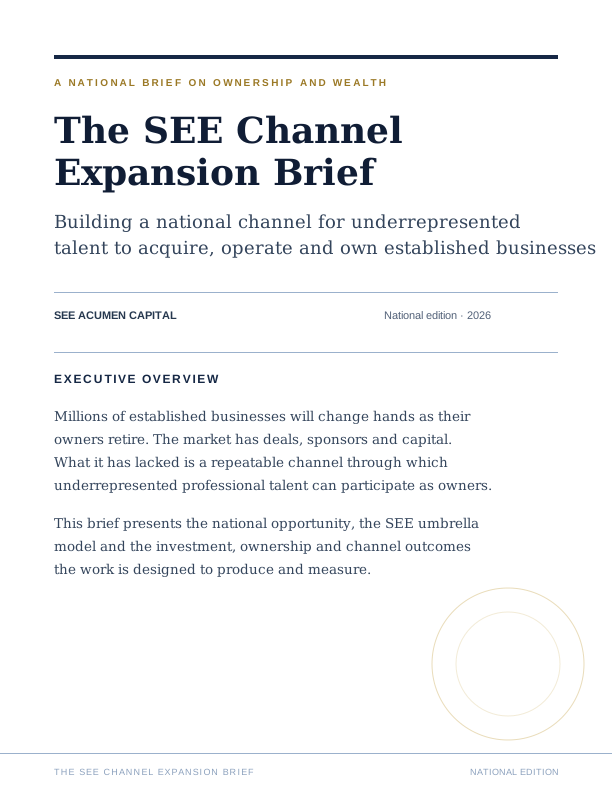
National research and investment thesis
What the brief covers
- The national transfer of lower-middle-market businesses
- The business-ownership and wealth gap
- Why underrepresented professional talent remains outside the acquisition channel
- How the SEE umbrella combines sponsors, operators, deals, capital and governance
- The case for competitive returns with measurable ownership impact
- The role of capital partners in building the channel
- Intended transaction, ownership and wealth-outcome measures